

Published in North of Oxford
Review by Greg Bem
As the world continues to project its complexity upon its inhabitants, complexity continues to become alarming and overwhelming. Inclusive in this intensity is the world of poetry, which finds its spectrum of weight and longevity continuing to expand in both directions. Poets are finding short form and long form content equally appealing, and opportunities to engage in discourse around cognition and limitation of “the reader.”
One such new release that explores the chiseled end of the spectrum is Who Will Find My Bodyby Charlie Zacks, a short collection of 56 pages that could be read, and reread, in a single sitting. Like haiku and lyrical poets more popularly present in poetic discourses of yesteryear, Zacks brings a refreshing suite of poetry forward capable of delivering much with little, but not lesser, verse.
Indeed, many of the poems have barely any lines at all; when counting the title, the length may be as little as two lines. In a clever vispo-like minimalism, “How to Die Without Dying” offers a mere pair of brackets, which may or may not serve as an invitation for the reader to figure the poem, and its symbolic potential, out on their own. But many of these poems are not clever linguistic lessons, and instead are more aphoristic, offering inquiries and statements through the youthful wisdom of this emerging poet. The minimalism persists from poem to poem, but the lines are both direct and dense, showcasing the power of precision in verse.
But Zacks is fascinating still in providing the reader with a book that has great range within itself. The most minimalist poems are not extinguished by their own briefness, but are instead charged alongside their longer sibling poems. The poet moves between the ecstatic blips and the slightly longer, exacerbated poems fluidly, allowing for a bountiful effect when read in concurrence. Not overtly conceptual, the poetry is varied enough in its presentation of literal, aphoristic, and abstract language, supported with a couple of list poems as well. Who Will Find My Body feels straight out of a New York School lineage. This “old school” poetry, matched with a contemporary queer speaker, feels present, alive, and of today.
Zacks has given us a collection that is worthy of being passed along and shared, a hymnal as bodily and psychic in its everyday presentation of ideas. It’s a fun read, one that chomps at the bit of reality, as the energy builds and builds. We might, through this poetry, ask about our own lives, our own relationships, our own perceptions and reflections, as we move through our own everyday vortex. Zacks may not have provided us with a map per se, but the poetry here may serve as visions of life’s songs—songs with beats to which we may dance along.
Published in Claudine, A Literary Magazine
Review by D.E. Hardy
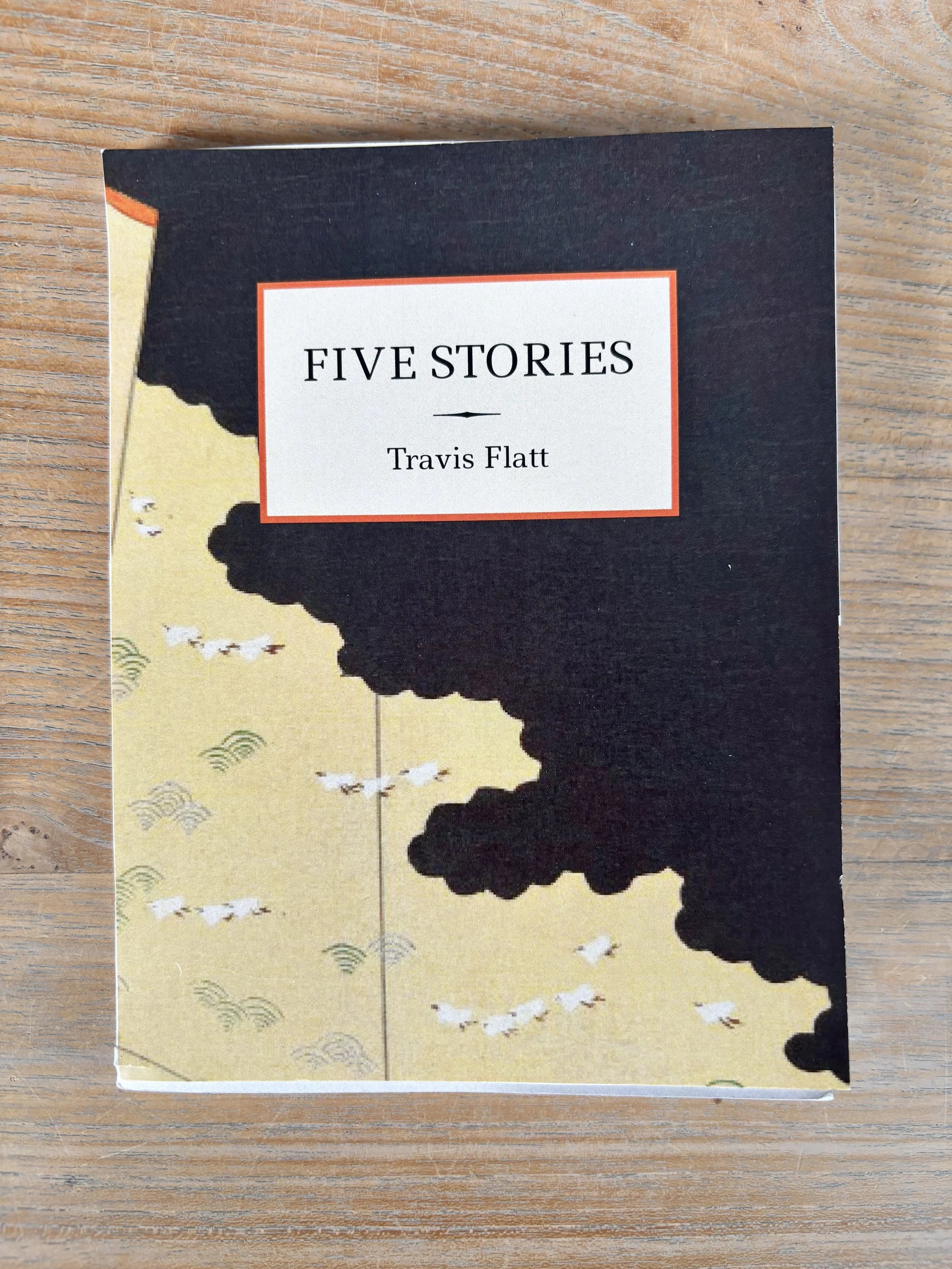
Travis Flatt’s Five Stories delivers wry, yet heartfelt storytelling that's ripe with spot-on dialogue and deliciously dysfunctional twists.
Flatt's subject varies widely—all the way from a dad afraid of talking truth to his anger-prone teen daughter to the court politics of the emperor who has no clothes—yet his narrative lens remains laser-focused on his characters, many of whom fall just short of their goals, resigned to near-miss their way through situations and relationships. Flatt’s a master of dialogue. His keen ear shapes his characters through what they say and (more importantly) don’t say. Even the prose of “The Newly Divorced Guy’s Homestyle Fish Stew,” which has almost no formal dialogue, reads like spoken text. That story opens with a full-throated voice that instructs the reader to “Pick a goddamn fish, you’re holding up the line.” And the humor! Wonderfully dry, often intentionally adolescent. As Newly Divorced Guy tells us of buying a fish: “When [the fishmonger] asks if he should ‘bone it,’ go ahead and laugh, but say, ‘No.’”
All five stories are stars, but it’s hard not to stan the first story, “My Dad’s Car,” extra hard. This story is quintessentially Flatt: a deadpan narrator (a teen son, in this case), adults poorly navigating their relationships, fantastic dialogue, and a proxy war through sports cars. The narrator’s dad drives a Ferrari. His stepdad, a Maserati. (His mom, interestingly, drives a Hyundai, a fact that hints at a whole other layer of story.) All the narrator, arguably, wants is a summer with his dad that is, at the very least, not lame. His dad, though, wants to hear all about the stepdad’s car and to show off his own. The dialogue is everything. The dad says: “Cool, cool. So,’ and he lowers his sunglasses, ‘you want to drive this son-bitch?” The son replies: “I don’t have a license.” For all the story’s fun—the ridiculous cars, the try-too-hard dad whose lexicon feels straight out of the 90s movie Wayne’s World—there’s a loneliness at its heart: a kid who can see that his adults, however much they want to connect with him, are lost in the fog of their own BS. And here, we can feel Flatt at our side, gently reminding us that humor doesn't come out of nowhere. Never does. So often, it's forged in hard moments—or in our young narrator's case, honed when you watch your dad and stepdad drag race away, each moment of acceleration taking them farther from you.
BOOK DETAILS
Five Stories can be purchased here.
Published by Sand and Gravel. The volume is 4.75”x 5.5” and includes 33 pages of prose. The book is hand-made with an old-school double-staple binding. Sand and Gravel is a new press, and Claudine is thrilled to see this newcomer enter the field—as well as their commitment to tiny books! This volume fits easily in glove compartments, purses, and perhaps most importantly, back pockets. Take this chap on your next lunch-hour walk, sit under an old tree, and read it in a single sitting. You will be glad you did. This is on-the-go sized literature, and we are here for it.